Free Newsletter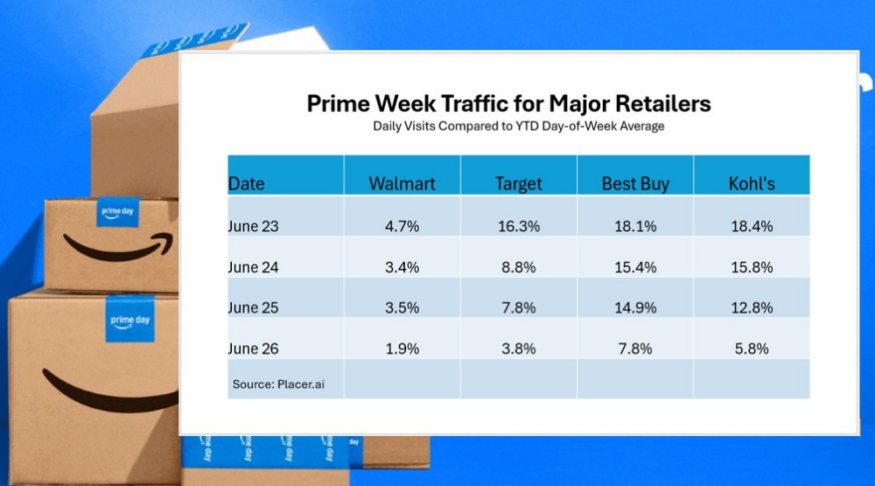
Big boxers see traffic boom during Amazon Prime event
Jennifer Marks// Editor in Chief//July 1, 2026


Fast Facts:
- Target and Kohl’s both saw double-digit store traffic growth on the first day of Prime week
- 52% of Amazon Prime consumers price-checked across retailers, with Walmart the most-checked competitor (67%), followed by Target (41%) and club retailers (28%)t
- At Amazon, the Home Goods category (bedding, décor, furniture, etc.) dropped from the 3rd most-shopped category in 2025 to 5th in 2026.
Santa Cruz, Calif. — Consumers treated Prime Day 2026 as a multi-retailer shopping event, driven part by competing promotions from store-based retailers.
Data from market research firm Numerator found that 52% of shoppers compared prices across retailers, with Walmart being the most commonly checked retailer (67%), followed by Target (41%) and club retailers (28%).
Foot traffic analysis from Placer.ai identified four big box retailers that reaped the greatest benefit: Walmart, Target, Kohl’s and Best Buy.
Target achieved the strongest year-over-year performance during the four-day event (June 23-26), while Best Buy came out on top with the strongest boost in incremental traffic, according to Placer.ai’s new report: What Prime Week 2026 Reveals About Today’s Shopper.
“Analyzing offline traffic to major retailers during Prime Day 2026 suggests that, although sentiment may be near record lows and value-seeking may now be a fixed habit, the appetite to spend is still there – although it has become more deliberate,” the Placer.ai report concluded.
Numerator’s preliminary results reflected that deliberation, finding that Prime Day 2026 ended with average household spending dropping by 10% compared to last year. Fewer shoppers splurged on consumer electronics this year (down 5 points to 14%), and overall deal satisfaction also fell back. Sixty percent said they were extremely or very satisfied with the Prime Day deals they perused, down from 67% last year.
Amazon’s Home Goods category (bedding, décor, furniture, etc.) was shopped by 23% of Prime members during the event, falling to the 5th most shopped category. During the summer 2025 Prime Day event, Home Goods was the 3rd most shopped category, generating purchases from about 25% of purchasers.
“After a slower start compared to last year, Prime Day shopping picked up slightly in the final 48 hours of the sale. However, this year’s Prime Day shoppers shied away from big-ticket purchases that were a hallmark of past events, prioritizing savings on essentials in an inflationary environment,” said Amanda Schoenbauer, Numerator analyst.
Related Content
Contributor Content

Vacation Vibes, Every Night: The Growing Interest in Travel-Inspired Bedding
Travel and beautiful locations around the world have always [...]
June 15, 2026
Contributor Content

Naia™ All-Night Comfort: Where fiber-level innovation meets better sleep
In today’s home textiles market, comfort isn’t a[...]
March 10, 2026